5 Surprising Ways to Manage Anxiety That Actually Work

You've probably heard the usual advice: breathe deeply, journal, go for a walk…
And those things are great! But if you've been dealing with anxiety for a while, you already know those tips.
So let's talk about some less obvious approaches that will work with your nervous system instead of just telling it to calm down (spoiler: telling your nervous system to calm down is basically the least effective strategy of all time).
Why most anxiety advice doesn’t address the whole picture
Most anxiety tips target the thinking brain — your prefrontal cortex, the part responsible for reason, planning, and logic. But when anxiety is activated, that part of your brain goes partially offline. Your body is running on instinct, not reason.
This is why you can know that everything is probably fine and still feel like it isn't (this is the #1 thing I hear from clients who are stuck in anxiety patterns). The knowing and the feeling are happening in different parts of your brain, and right now the feeling is driving.
The tools below work differently. They target your nervous system directly — your body, your senses, your relationships — instead of trying to think your way out of a physiological response.
Here are 5 unexpected ways to manage anxiety (that actually work):
1. Smell something on purpose.
Aromatherapy sounds like something you'd find next to a crystals display at a wellness boutique, but there's real neuroscience behind it!
It has everything to do with how your brain is wired. Smell is the only sense with a direct pathway to the amygdala, which is the part of your brain that processes fear and threat. Every other sense (sight, sound, touch, taste) gets routed through a relay station first. Because smell basically skips the line, it can shift your nervous system's state faster than almost anything else.
Certain scents have been studied specifically for their calming effects. Lavender is the most well-known, with research showing it can reduce heart rate and lower cortisol. Bergamot (a citrus used in Earl Grey tea) has shown up in studies as a mood-lifter. Clary sage has been linked to reduced anxiety in some clinical settings.
You don't need to overhaul your whole self-care routine, but maybe keep a small bottle of lavender essential oil on your desk or in your bag. When anxiety spikes, open it and take a few slow inhales. It's not a cure, but it's a fast, accessible tool that can help.
2. Eat some sour candy.
This one sounds like a joke. It is not a joke.
Your vagus nerve — the long, wandering nerve that connects your brain to most of your major organs and plays a central role in regulating your nervous system — runs directly through your throat and mouth. Stimulating it sends a fast signal to your parasympathetic system. And one surprisingly effective way to do that? Strong sensory input in the mouth.
Sour candy works because it demands your full sensory attention. The intensity of the flavor pulls your brain out of the anxiety spiral and into the present moment. Your body can't really be in threat mode and processing "extremely sour Warhead" at the same time. Some somatic therapists actually keep sour candy in their offices as a grounding tool for exactly this reason.
Other types of hard candy work similarly. The sustained sucking motion activates a calming oral response (this is the same reason people find chewing gum helpful under stress, just more potent). Strong mints, sour gummies, spicy candies, or anything that creates an intense, immediate sensory experience in your mouth can do the trick.
Keep a few in your bag, your desk drawer, your car. When anxiety spikes and you need to land back in your body fast, reach for one before you reach for your phone.
3. Get curious about the part of you that’s anxious.
Most of us relate to anxiety like it's an intruder: something to suppress, distract from, or push through. I mean, it makes sense. Anxiety doesn't feel good, and fighting it feels productive. But… when you treat anxiety like an enemy, it just gets louder.
A different approach, one rooted in parts work (a framework called IFS, or Internal Family Systems), is to get curious about the anxious part of you instead of trying to get rid of it. What is it worried about? What is it trying to protect you from? What does it need in order to feel less activated?
Anxiety almost always has a job. It's not malfunctioning — it's working overtime to keep you safe, usually based on old experiences that taught you the world wasn't safe or that you weren't enough. When you acknowledge that instead of fighting it, that part starts to shift. This doesn't mean indulging every anxious thought or letting it run the show, but maybe pausing to ask "What are you trying to tell me?" before immediately trying to make it stop.
You don't have to have any background in therapy or IFS to try this. Next time anxiety shows up, try placing a hand on your chest and saying (internally or out loud): "I notice something in me is scared right now. That makes sense." Then simply see what happens.
4. Spend time near water.
This one sounds almost too easy, but the research on what's sometimes called "blue mind" — the psychological and physiological effects of being near water — is so interesting! Water environments (oceans, lakes, rivers, even fountains) have been shown to reduce stress hormones, lower heart rate, and improve mood. The sound of moving water activates the parasympathetic nervous system (it's the same reason rain sounds are one of the most popular sleep aids on the planet!).
Part of this is sensory. The rhythmic sounds of water engage your attention in a soft, diffuse way, which gives your overactive mind something to observe without demanding focus. Basically, it's the opposite of doomscrolling.
You don't need to live near the beach to make this work. A local park with a creek, a fountain in a courtyard, even a white noise app that plays water sounds can offer some of the same benefit. If you find yourself anxious and stuck indoors, try pulling up water sounds on your phone, closing your eyes, and just listening for five minutes.
5. Try some bilateral stimulation.
Some what now?
“Bilateral stimulation” is a fancy term that basically refers to alternating left-right sensory input in your body. This is a core element of EMDR (Eye Movement Desensitization and Reprocessing), and the theory is that rhythmic, alternating activation of both hemispheres of the brain helps interrupt the loop of anxious or distressing thoughts.
One of the simplest forms that you can do solo is called a butterfly hug: cross your arms over your chest, place each hand on the opposite shoulder, and tap alternately — left, right, left, right — at a slow, steady rhythm while breathing. Keep going for a minute or two.
You can also do this by tapping alternating hands on your thighs (we call this “shark fins” hehe), or even alternating feet on the floor. The key is the rhythm and the alternating pattern, not the specific movement.
It sounds almost too simple to work. But if you're in a spiral and you try it, you'll likely notice a slight loosening in your body or that the spiral has slowed down. That's your two hemispheres coming back online together!
At the end of the day, anxiety is a nervous system response — one that made a lot of sense at some point. If your anxiety has gotten a little out of hand, there are so many creative ways to work with it!
These tools help you build a different relationship with your anxiety: one where you know how to work with your body, lean on the world around you, and meet the anxious part of yourself with a little more curiosity and a little less fighting.
If you want to dive deeper into how anxiety works and learn science-backed tools to work with it, check out my in-depth guide, Find Your Calm! Learn more here.
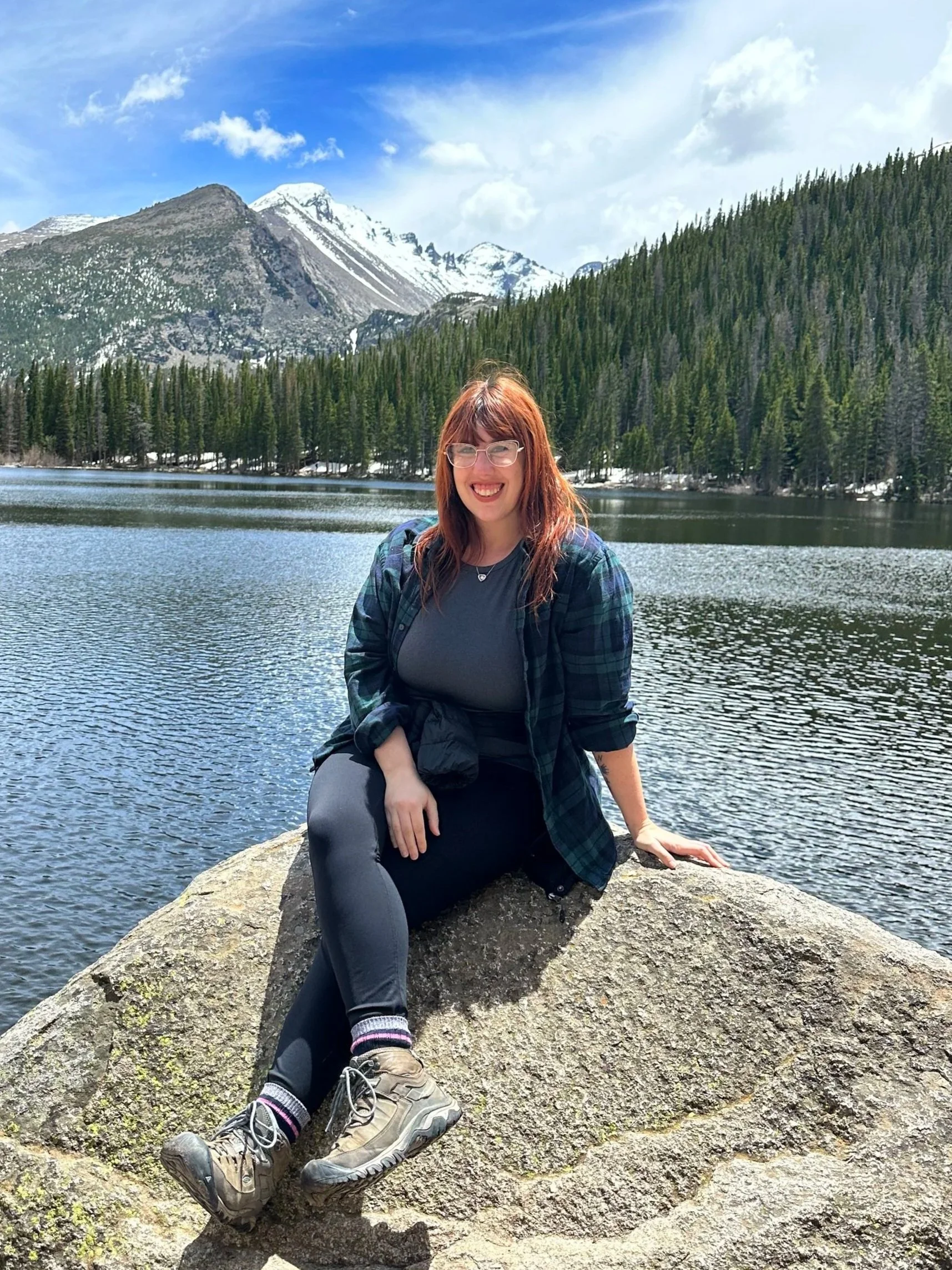
Hi, I’m Laura (she/her), a licensed anxiety and trauma therapist.
I provide holistic online therapy in Los Angeles and across California, serving anxious people-pleasers, high achievers, and neurodivergent adults who are ready to explore themselves deeply and live a fuller, more meaningful life. I work with folks navigating anxiety, trauma, neurodivergence, LGBTQIA+ identity, and challenging relationships.
By integrating both experiential and evidence-based techniques, such as ACT, EMDR, Brainspotting, IFS, and mindfulness, I provide therapy that addresses the mind, body, and soul. My goal is to help you feel less anxious, heal from painful past experiences, and find your way back home to yourself.
Learn more about me here!